
Origins and Purpose
The Foreign Agents Registration Act (“FARA”) was enacted by Congress in 1938 to require individuals doing political or advocacy work within the United States on behalf of a foreign principal, to register their activities and relationship with the Department of Justice (DOJ). FARA was enacted just prior to the United States entry into World War II, with the objective of increasing transparency regarding foreign propaganda and influence in the United States, particularly associated with the Axis powers. The Act does not prohibit any behavior, but it requires disclosure where foreign principals are involved.
FARA was originally administered by the Department of State but was transferred to the Department of Justice in 1942, as the State Department lacked the institutional capacity at the time to administer and enforce the statute effectively. Since its transfer to the DOJ, FARA has been amended numerous times over its eight decades of existence, and its registration trends have changed accordingly.
FARA registration data is generally divided into three categories. First, primary registrants are organizations (such as lobbying firms, law firms, and public relations agencies) that generally have the main agreement with a foreign principal. Second, short-form registrants are individuals associated with the primary registrants who engage in covered activities. Third, foreign principals are the entities represented, including foreign governments, companies, or individuals. As noted in a March 2026 Congressional Research Service report, nearly every country in the world has had at least one foreign agent registered under FARA in the last 20 years.
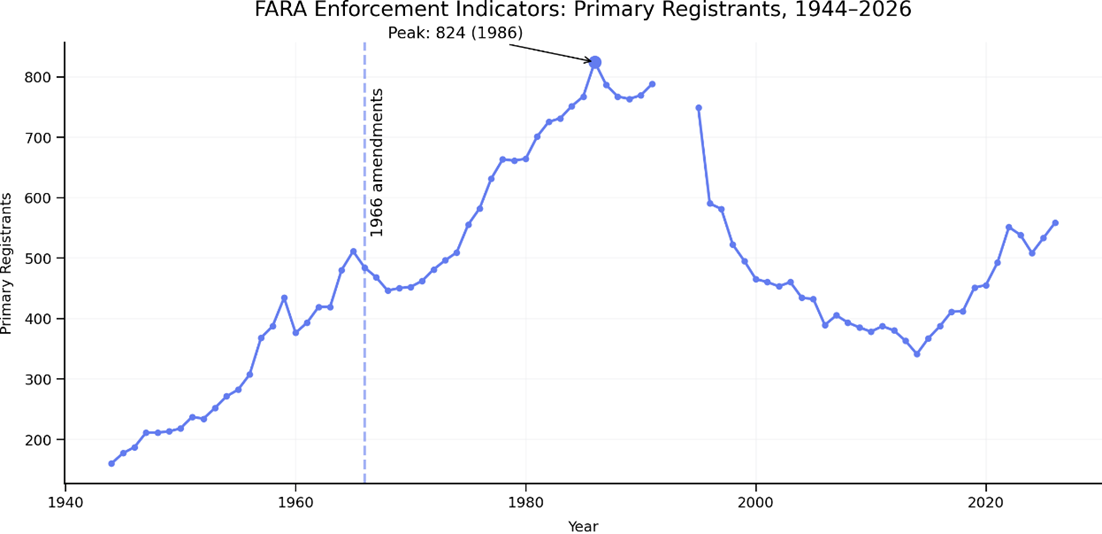
*Data from 1992–1994 is not included because the corresponding DOJ FARA reports are not available in DOJ’s public online archive
Early Enforcement and Postwar Decline
At FARA’s outset in the early 1940s, registration increased steadily as the government actively investigated and administered the Act during the wartime period. Following WWII, registration continued to grow slowly, but enforcement activity declined as the wartime conditions that had driven initial enforcement diminished. Registration also increased gradually during the Cold War, although criminal enforcement remained relatively limited compared to later periods with relatively few indictments brought between the 1960s and 1990s.
The 1966 Amendments and Modern Framework
In 1966, Congress substantially amended the Act to reflect changes associated with the emergence of a more globalized economy and shifted its focus towards political activities and lobbying on behalf of foreign principals. Registration data does not reflect an immediate increase following these amendments, rather, the number of primary registrants declined slightly from 1966 to 1968 before gradually increasing in subsequent years.
The LDA and 1990s Registration Decline
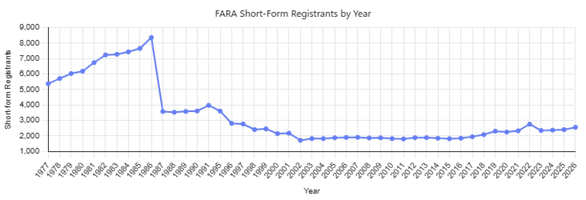
Primary registrants peaked in the late 1980s before declining sharply in the mid‑1990s, a pattern that corresponds with the enactment of the Lobbying Disclosure Act (“LDA”) in 1995. Like FARA, the LDA is a disclosure statute intended to promote transparency in lobbying activities, but it regulates lobbying generally rather than foreign influence specifically. The LDA significantly impacted FARA because the Act provides an exemption that allows certain individuals or entities to register under the LDA instead of FARA. This exemption coincided with a sharp decline in FARA registrations, as reflected across all three datasets. The FARA exemption in the LDA has been the subject of an ongoing policy debate, with some legislators arguing that lobbyists should be required to register under both laws, or FARA should include an LDA exemption instead, but changes have yet to be made.
Post‑2016 Resurgence
FARA registrations declined in the decades following enactment of the LDA exemption, a trend that continued until reports of foreign interference began to circulate, following the 2016 election. This sparked a renewed concern over foreign influence which is reflected in registration numbers across all three datasets. Since 2016, the number of registrants and foreign principals have begun to rise, indicating concerns about foreign influence have remained prevalent. Several high-profile cases of FARA enforcement have also increased public awareness of the statute, likely contributing to increasing registration.
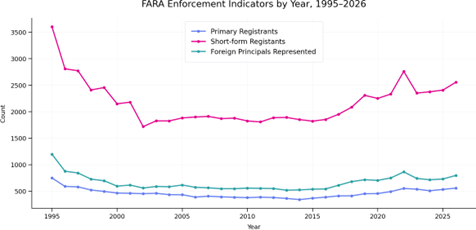
FARA registration trends help demonstrate the Act’s history, its registration fluctuating as it has evolved over time in response to statutory changes and enforcement priorities. The recent increase in FARA registrations and enforcement suggests renewed concern about foreign influence in American politics with FARA at the forefront as a means of addressing these concerns.
Special thanks to Sonia de Jong for her efforts on this Blog piece.
For more information regarding FARA, please contact us using our online form.

An Informational Resource in a New Era of Foreign Agents Registration Act Enforcement.
Search
Recent Blog Posts
- Final Rules (Finally)?
- A Look Back: The Billy Carter Affair
- A Look Back: The Tongsun Park Case
- A History of FARA Registration
- A Look Back: The 1941 Prosecution of Aviator Laura Ingalls
- A Look Back: The 1992 Indictment of Sam Zakhem, a Rare FARA Case in the 1990s
- A Look Back: The 1951 Trial of the Peace Information Center and W.E.B. Du Bois
- Jury Convicts Former Florida Congressman David Rivera of FARA Violations
- FARA.us Releases Updated Advisory Opinion Index
- FARA and Nonprofits: Recent Developments and Compliance Considerations
Bios
Archives
- August 2026
- July 2026
- June 2026
- May 2026
- March 2026
- November 2025
- October 2025
- September 2025
- March 2025
- February 2025
- December 2024
- September 2024
- August 2024
- July 2024
- June 2024
- May 2024
- January 2024
- July 2023
- December 2022
- November 2022
- October 2022
- May 2022
- April 2022
- March 2022
- January 2022
- December 2021
- October 2021
- July 2021
- March 2021
- February 2021
- December 2020
- November 2020
- September 2020
- June 2020
- May 2020
- February 2020
- October 2019
- September 2019
- August 2019
- July 2019
- June 2019
- May 2019
- April 2019
- March 2019
- February 2019
- January 2019